
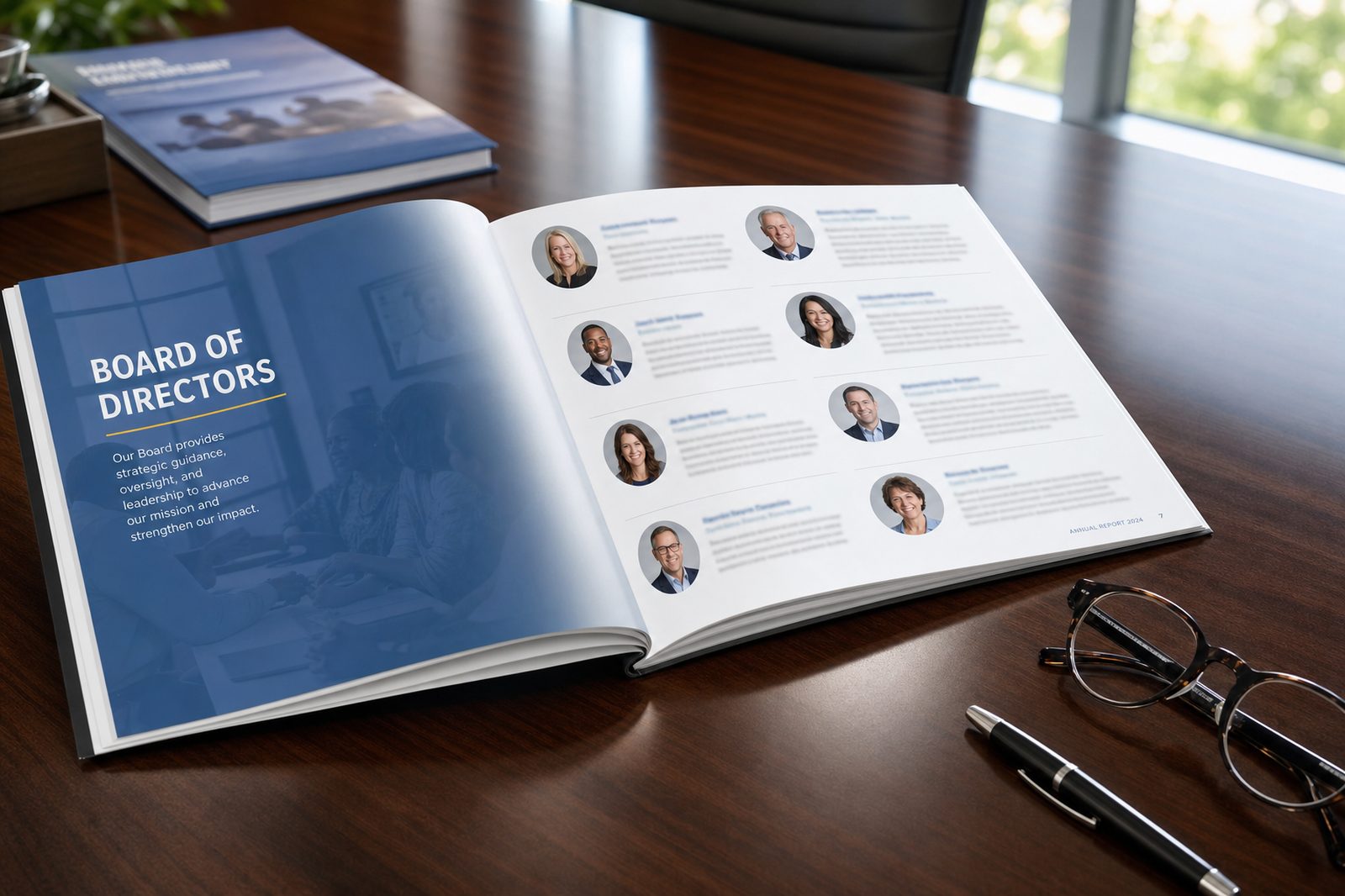
Organizations with detailed board member bios receive 28% more online donations than those without board information, according to BoardSource research. Your board bios appear in annual reports, grant proposals, websites, and fundraising materials—yet 73% of nonprofits use inconsistent or poorly formatted bios that undermine credibility. This guide provides 5 copy-paste templates plus the exact 6-part structure that works.
What Is the Ideal Board Bio Structure?#
The optimal board bio is 125-175 words following a 6-part structure. Bios under 100 words appear incomplete; bios over 200 words don't get read. The 150-word target hits the sweet spot for annual reports, websites, and grant proposals.
| Section | Word Count | Purpose |
|---|---|---|
| 15-25 words | Establish professional credibility |
| 25-35 words | Prove relevant expertise |
| 20-30 words | Show specific value to org |
| 20-25 words | Demonstrate local connections |
| 20-30 words | Humanize with motivation |
| 15-20 words | Show governance commitment |
Template 1: Corporate Executive Board Member#
Copy this template for board members from the corporate sector:
[FULL NAME] serves as [TITLE] at [COMPANY], where [he/she/they]
[PRIMARY RESPONSIBILITY]. With [NUMBER] years in [INDUSTRY],
[FIRST NAME] has led initiatives that [QUANTIFIED ACHIEVEMENT].

[He/She/They] brings expertise in [SKILL 1], [SKILL 2], and
[SKILL 3] to [ORGANIZATION NAME]'s board. Active in [COMMUNITY
ORGANIZATION], [FIRST NAME] also serves on [OTHER BOARD/COMMITTEE].

Inspired by [PERSONAL CONNECTION TO MISSION], [FIRST NAME] joined
the board in [YEAR]. [He/She/They] chairs the [COMMITTEE NAME]
Committee and lives in [CITY] with [FAMILY DETAIL].
Example (147 words):
Sarah Chen serves as Chief Financial Officer at Pacific Healthcare Systems, where she oversees $450 million in annual operations across 12 regional facilities. With 18 years in healthcare finance, Sarah has led cost reduction initiatives saving over $15 million while improving patient outcomes. She brings expertise in financial planning, regulatory compliance, and strategic growth to Sunrise Foundation's board. Active in Women in Healthcare Leadership, Sarah also serves on the Regional Hospital Association's audit committee. Inspired by her grandmother's Alzheimer's diagnosis, Sarah joined the board in 2021 to support dementia research and family caregiver resources. She chairs the Finance Committee and has helped secure three consecutive clean audits. Sarah lives in Portland with her husband and two daughters.
Template 2: Community Leader Board Member#
Copy this template for board members without traditional corporate backgrounds:
[FULL NAME] is a [DESCRIPTOR] who has served [COMMUNITY] for
[NUMBER] years. As [ROLE/TITLE], [he/she/they] [KEY CONTRIBUTION
OR ACHIEVEMENT].

[FIRST NAME] brings firsthand understanding of [ISSUE/POPULATION]
to [ORGANIZATION NAME]'s board. [His/Her/Their] lived experience
including [RELEVANT PERSONAL EXPERIENCE] informs board discussions
about [PROGRAM AREA].

A graduate of [SCHOOL/PROGRAM], [FIRST NAME] also volunteers with
[ORGANIZATION]. [He/She/They] joined the board in [YEAR] and serves
on the [COMMITTEE] Committee. [FIRST NAME] lives in [NEIGHBORHOOD/CITY].
Example (142 words):
Maria Gonzalez is a parent advocate who has served East Portland families for 15 years. As founder of Padres Unidos, she has connected over 2,000 immigrant families with educational resources and legal support. Maria brings firsthand understanding of the barriers facing immigrant communities to Centro Cultural's board. Her lived experience as a first-generation immigrant and mother of four informs board discussions about family programming and language access. A graduate of Portland Community College's community leadership program, Maria also volunteers with the school district's family engagement committee. She joined the board in 2020 and serves on the Programs Committee. Maria lives in the Cully neighborhood, where her family has resided for 22 years.
Template 3: Retired Professional Board Member#
Copy this template for retired board members contributing expertise:
[FULL NAME] retired in [YEAR] after a [NUMBER]-year career as
[ROLE] at [ORGANIZATION]. During [his/her/their] tenure,
[he/she/they] [KEY CAREER ACHIEVEMENT].

Now [FIRST NAME] dedicates [his/her/their] expertise in [SKILL 1]
and [SKILL 2] to organizations including [ORGANIZATION NAME].
[He/She/They] currently [CURRENT ACTIVITY: consults, mentors, etc.].

[FIRST NAME] has served on [ORGANIZATION NAME]'s board since [YEAR],
currently chairing the [COMMITTEE] Committee. A longtime [CITY]
resident, [he/she/they] [HOBBY OR COMMUNITY ACTIVITY].
Example (138 words):
Robert Williams retired in 2019 after a 35-year career as Superintendent of Jefferson County Schools. During his tenure, he increased graduation rates from 71% to 89% and expanded career technical education programs serving 5,000 students annually. Now Robert dedicates his expertise in educational leadership and community partnerships to organizations including Youth Futures Alliance. He currently mentors new superintendents through the State Education Leadership Institute. Robert has served on Youth Futures Alliance's board since 2020, currently chairing the Education Committee. He previously served on boards for United Way and the Regional Workforce Development Council. A longtime Denver resident, Robert coaches youth basketball and volunteers at his church's food pantry.
Template 4: Young Professional Board Member#
Copy this template for emerging leaders on your board:
[FULL NAME] is a [TITLE] at [COMPANY] specializing in [SPECIALTY].
Since joining [COMPANY] in [YEAR], [he/she/they] has [ACHIEVEMENT].

[FIRST NAME] brings fresh perspective on [TOPIC 1] and [TOPIC 2]
to [ORGANIZATION NAME]'s board. [He/She/They] represents
[DEMOGRAPHIC OR CONSTITUENCY] voices in governance discussions.

A [UNIVERSITY] graduate, [FIRST NAME] was recognized as [AWARD/
HONOR]. [He/She/They] joined the board in [YEAR] through the
[PROGRAM, e.g., Emerging Leaders program] and serves on the
[COMMITTEE] Committee. [FIRST NAME] lives in [CITY].
Example (135 words):
Amanda Torres is a Digital Marketing Manager at TechStart Inc. specializing in social media strategy and content creation. Since joining TechStart in 2022, she has grown the company's social following from 5,000 to 47,000 and increased engagement by 340%. Amanda brings fresh perspective on digital communications and Gen Z engagement to Arts Access's board. She represents young professional voices in governance discussions about reaching new audiences. A University of Oregon graduate, Amanda was recognized on Portland Business Journal's "40 Under 40" list in 2024. She joined the board in 2023 through the Emerging Leaders program and serves on the Marketing Committee. Amanda lives in the Pearl District.
Template 5: Professional Services Board Member#
Copy this template for attorneys, accountants, consultants, and similar professionals:
[FULL NAME] is a [TITLE] at [FIRM] where [he/she/they] advises
clients on [SPECIALTY]. [He/She/They] has [NUMBER] years of
experience in [FIELD].

[FIRST NAME] provides pro bono [SERVICE TYPE] to [ORGANIZATION
NAME] and serves on the board, bringing expertise in [AREA 1] and
[AREA 2]. [He/She/They] has helped the organization [SPECIFIC
CONTRIBUTION].

[FIRST NAME] earned [DEGREE] from [SCHOOL] and holds [CERTIFICATION].
[He/She/They] joined the board in [YEAR] and chairs the [COMMITTEE]
Committee. [He/She/They] lives in [CITY] with [FAMILY].
Example (145 words):
Jennifer Park is a Partner at Morrison & Associates where she advises nonprofit and tax-exempt clients on governance, compliance, and tax matters. She has 14 years of experience in nonprofit law. Jennifer provides pro bono legal counsel to Habitat Portland and serves on the board, bringing expertise in nonprofit compliance and risk management. She has helped the organization update bylaws, establish conflict of interest policies, and navigate a successful merger with a neighboring affiliate. Jennifer earned her JD from Lewis & Clark Law School and holds nonprofit governance certification from BoardSource. She joined the board in 2019 and chairs the Governance Committee. Jennifer lives in Lake Oswego with her husband and three children.
What Are the 7 Most Common Board Bio Mistakes?#
| Mistake | Problem | Fix |
|---|---|---|
| Doesn't get read; looks self-important | Edit to 150 words maximum |
| Claims without proof lack credibility | Add 2-3 specific numbers |
| Lists former employers; damages trust | Review and update annually |
| "Synergizing stakeholder value" means nothing | Use plain language |
| No explanation of why they serve | Add 1 sentence on motivation |
| Different lengths and structures look sloppy | Use same template for all |
| Reader doesn't know their contribution | Include committee/tenure |
How Should You Format Bios for Different Uses?#
Website bios (150 words + photo): Include professional headshot, full 150-word bio, and link to LinkedIn if appropriate. Update photos every 2-3 years.
Annual report bios (100-125 words): Trim to essential credentials, board role, and mission connection. Space constraints require prioritization.
Grant proposals (varies by funder): Emphasize credentials relevant to the grant. Education grant? Highlight education background. Healthcare funding? Feature medical professionals prominently.
Event programs (50-75 words): Name, title, organization, board role, and one sentence of context. Example: "Sarah Chen, CFO of Pacific Healthcare Systems, chairs Sunrise Foundation's Finance Committee and has served since 2021."
What Process Creates Consistent Quality Bios?#
Step 1: Send structured questionnaire. Ask for: current role and employer, 2-3 career highlights with numbers, relevant skills, community involvement, personal connection to mission, board committee and start date, city of residence, and optional family information.
Step 2: Draft bio using template. Staff drafts bio following organization's standard template. Board member approves accuracy rather than writing from scratch.
Step 3: Get approval. Send draft to board member with 5-day deadline. Note: "Please verify accuracy and approve, or send corrections."
Step 4: Annual refresh. Every January, email all board members: "Please review your bio and send any updates by January 31." Track who responds.
Frequently Asked Questions#
How long should a board member bio be?#
The ideal board bio is 125-175 words. Bios under 100 words appear incomplete and fail to establish credibility. Bios over 200 words don't get read completely—readers skim and miss key information. The 150-word target works for websites, annual reports, and grant proposals.
Should board bios be written in first or third person?#
Always use third person ("she serves" not "I serve"). Third person is standard for professional bios and creates appropriate distance. First person sounds casual and is inconsistent with how other organizational materials reference leadership.
What if a board member has multiple roles?#
Feature their most relevant role prominently, then mention 1-2 others briefly. Example: "Beyond his work as CTO at TechCorp, James serves on the Innovation Foundation board and teaches at the university." Listing more than 3 roles makes the bio sound scattered.
How do you handle board members without impressive credentials?#
Emphasize lived experience and community connections. Not every board member needs a C-suite title. Community members bring perspectives executives cannot. Frame their value: "Maria brings 15 years of firsthand experience navigating services as a single mother to board discussions about family programming."
Should board bios mention personal hobbies?#
Generally no—use that space for mission connection instead. "Enjoys hiking and reading" adds personality but wastes 4-5 words better used establishing relevance. Exception: hobbies that connect to mission. Animal shelter board? "Shares her home with three rescue dogs" reinforces commitment.
How often should board bios be updated?#
Review all bios annually; update immediately when major changes occur. New job, significant award, or change in board role warrant immediate update. Schedule annual review every January. Outdated bios listing former employers damage organizational credibility.
Strong board bios showcase leadership that builds donor confidence, strengthens grant applications, and demonstrates organizational credibility. Use these templates to create consistent, compelling bios for every board member. For faster bio creation, try River's nonprofit writing tools to generate and polish professional content.